Battery Operated Stacker: 6 Things to Check Before You Buy
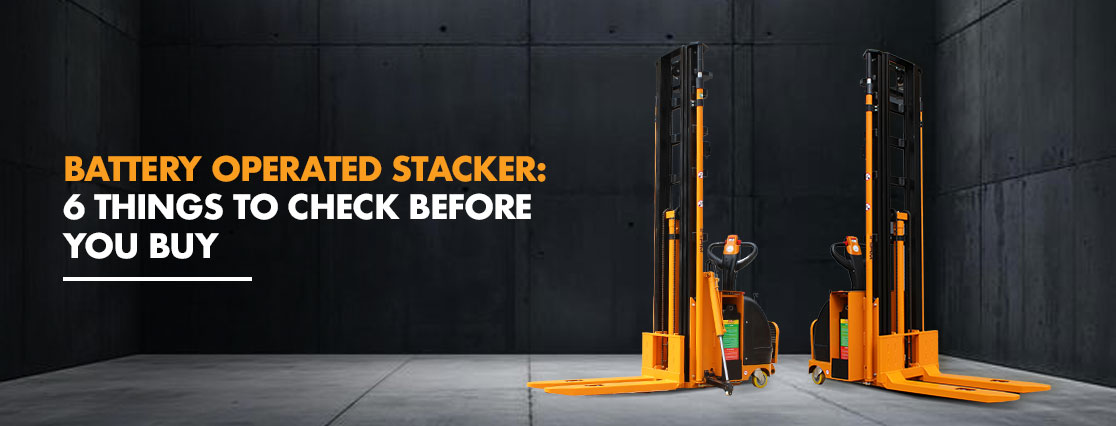
A stacker purchase can look straightforward on paper. Pick a capacity, compare a few prices and place the order. But six months later, the machine that seemed like a bargain may struggle with your racking height, drain its battery mid-shift or turn out to be too wide for the aisles it was bought for.
At Maini Materials Movement, we know that choosing the right stacker is about more than comparing capacities and prices. It starts with understanding how the machine will actually be used in your operation.
From load capacity and lift height to aisle space, battery requirements and long-term service support, these are the six things we recommend checking before buying a battery operated stacker.
How Much Weight Will the Stacker Actually Lift?
Start with your heaviest regular load, not your average one. A battery operated stacker is rated for a maximum capacity, and running it near that limit all day shortens its life and strains safety margins.
The practical rule: note your heaviest pallet, add a comfortable buffer, and select the capacity above that. Buying slightly higher capacity costs a little more today and saves the machine, and possibly an accident, tomorrow. Remember also that rated capacity reduces as lift height increases, so check the load chart, not just the headline number.
What Lift Height Does Your Racking Demand?
Measure the top beam of your tallest rack, then add clearance for the pallet to lift over it. That figure, not a guess, decides the mast you need.
This is also where buyers overspend or underspend most. Too short a mast makes your top racks useless. Too tall a mast adds cost and can create trouble with low doorways and mezzanine ceilings. Ten minutes with a measuring tape settles what weeks of catalogue browsing cannot.
Will It Move Freely in Your Aisles?
Every stacker has a turning radius, and every warehouse has its tightest corner. The two must agree.
Check your narrowest aisle, doorway widths and any congested junctions along the routes the machine will travel daily. Compact models with small turning circles exist precisely for tight Indian warehouse layouts. Confirm the fit on paper first, because no feature compensates for a machine that cannot turn where you need it to.
How Long Are Your Shifts and How Will You Charge?
Battery requirements can make or break the purchase. At Maini Materials Movement, we recommend starting with two key questions.
First, how many hours a day will the machine run? A single-shift operation charges comfortably overnight. Multi-shift operations need to think about battery capacity, charging windows or spare batteries.
Second, where will it be charged? Having a dedicated charging point close to the work area, with time factored into the routine, ensures the machine is available when needed. Lithium options that charge more quickly and allow for opportunity top-ups during breaks have also changed this equation. Added to this, we introduced lithium-powered vehicles in 2021 to offer this flexibility to operations with varying usage requirements.
Should You Choose Semi-Electric or Fully Electric?
Not every operation needs full power, and this is where an honest look at your usage saves real money.
A semi-electric stacker powers the lifting but is pushed manually. For light loads, short distances and occasional use, it does the job at a friendlier price. A fully electric stacker powers both lifting and travel, which becomes essential when loads are heavy, distances are long, or the machine works through full shifts.
If the machine will work hard and often, a fully electric stacker can deliver greater productivity and reduce operator effort. If it will be used occasionally, a semi-electric stacker may be the more practical starting point.
Our range of stackers include manual, semi-electric, fully electric and counterbalanced stackers, allowing us to recommend a solution based on the actual requirements of your operation.
Who Will Support the Machine After the Sale?
A stacker is a ten-year relationship, not a one-time transaction. Ask the seller, before you buy, where the service engineers are based, how quickly they can get spares, if they offer preventive maintenance.
That is the real benefit of choosing an established manufacturer.
At Maini Materials Movement, with over 40 years of experience in material handling, over 17,000 MHEs sold and a dedicated service network, we support machines throughout their entire working life, from installation and operator familiarisation to spare parts and scheduled maintenance.
FAQs
How long does a stacker battery last on a charge?
It depends on the battery's capacity and how intensively it's used. Share your shift pattern and we'll recommend the right configuration.
Can a battery-powered stacker truck work in narrow aisles?
Yes, compact models with small turning radiuses are made for tight spaces.
Do electric stackers require operator training?
Yes, basic training is important for safety, and our team helps with operator familiarization.
Can I switch from semi-electric to fully electric later?
A lot of customers start with semi-electric and upgrade as their operations expand.
Do you rent stackers prior to buying them?
Yes, we offer rentals so you can validate the fit before you buy.
Find the Right Stacker for Your Operation
Every warehouse has different requirements. The right battery-operated stacker depends on your load capacity, lift height, aisle dimensions, duty cycle, and operational needs.
Talk to our team to find the right stacker for your operation.
https://www.mainimaterials.com/contact-us


